
The SAFE CH4Rice (Methane Emissions from Rice Crops) project continues to advance water inundation monitoring across Asia, supporting improved methane (CH4) emission estimation and sustainable water management in rice cultivation. The project is led by the Vietnam National Space Center (VNSC) and was approved as a multilateral SAFE initiative at APRSAF-28 in November 2022. The project focuses on the use of Earth Observation (EO) data, in-situ measurements, and improved water management practices such as Alternate Wetting and Drying (AWD).
A core component of CH4Rice is water inundation monitoring, which underpins accurate methane emission estimation. The project applies full-polarimetric L-band Synthetic Aperture Radar (SAR) data, including ALOS-2 PALSAR-2 and ALOS-4 PALSAR-3, which can penetrate rice canopies and detect surface water beneath crops. Inundated paddy fields exhibit strong double-bounce scattering, enabling reliable identification of flooded conditions when combined with ground-based observations.
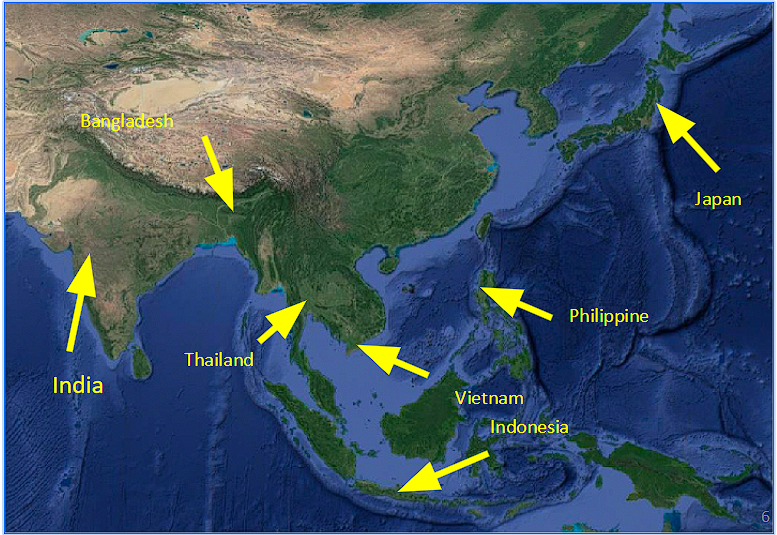
As of November 2025, CH4Rice water inundation monitoring activities are underway at selected supersites across participating countries, including Indonesia, Thailand, India, Japan, the Philippines, Bangladesh, and Vietnam.
In Bangladesh, six AWD sites with automated water-table monitoring were established in Rajshahi, contributing to 89 AWD sites nationwide, with support from the Bangladesh Agricultural Research Council (BARC). Pilot activities using IoT-based smart irrigation demonstrated reduced CH4 emissions in AWD fields and were reported at a national workshop in September 2025.
In Japan, water inundation monitoring has progressed through the installation of automatic water-level sensors and gas sampling systems for CH4 and N2O. UAV lidar campaigns and portable methane sensor testing were conducted in 2025, alongside collaboration with the University of Tokyo to develop three-dimensional rice crop models for SAR-based analysis. A peer-reviewed paper on L-band SAR geometry effects for water management monitoring was published in 2025.
In the Philippines, AWD implementation is being prepared under the Joint Crediting Mechanism (JCM), targeting coverage of 30,000 hectares by 2030. Preliminary flux measurements from Nueva Ecija were presented at AsiaFlux in October 2025, and further methane monitoring instrumentation is scheduled for installation in early 2026. Initial analyses indicate strong relationships between plant height and radar volume scattering.
In Indonesia, water inundation monitoring activities are underway at four study sites in Subang, West Java. Field measurements collected over three planting seasons were combined with Sentinel-1 and ALOS-2 data to estimate methane emissions using IPCC methodologies. IoT radar sensors recorded CH₄ flux, water level, crop height, and soil conditions, alongside capacity-building activities with the Ministry of Agriculture and JAXA.
In Thailand, monitoring activities include field measurements and satellite data analysis across Suphan Buri and Chainat provinces. A total of 22 automatic water-level sensors have been deployed, supported by manual measurements at additional sites. Multi-sensor analyses using Sentinel-1 and ALOS-2 data have enabled the classification of rice growth stages and flooding regimes, with methane emissions estimated under different water management practices. Project findings were published in the Remote Sensing journal in June 2025.
In Singapore, Nanyang Technological University (NTU) announced plans to collaborate with partners in Vietnam to deploy approximately 100 low-cost IoT sensors, supporting scalable integration of in-situ and satellite-based inundation monitoring and improved MRV accuracy.
CH4Rice continues to strengthen the scientific evidence base for EO-enabled methane monitoring through field validation, satellite data integration, and peer-reviewed publications. These efforts support climate mitigation strategies, sustainable water use in rice production, and the development of future policy and market-based mechanisms such as carbon credits.